Replace A Full Arch Of Teeth
01
Multiple dental implants may support replacement teeth for a complete upper or lower arch where clinically appropriate, following detailed assessment and planning.
If you are considering full arch dental implants and live near Becket Keys Church of England School, this page explains what the treatment means, how we plan care and what to expect at Start Smiling Dental Practice in Ingatestone. Multiple dental implants are placed in the jawbone to support replacement teeth across a full upper or lower arch, and careful assessment and planning guide each personalised plan. Assessment and planning for full arch dental implants include X-rays, scans and restorative planning; our dental implant treatment information outlines the diagnostic steps we commonly use.
Start Smiling Dental Practice is based in Ingatestone and welcomes enquiries from people near Becket Keys Church of England School who are exploring full-arch options. Multiple dental implants are placed in the jawbone to support replacement teeth across a full upper or lower arch, and your treatment is tailored to your anatomy, bite and personal goals. We explain alternatives, the investigations required and how risks are managed so you can make an informed decision.
Potential benefits of full-arch implant solutions include:
Multiple dental implants may support replacement teeth for a complete upper or lower arch where clinically appropriate, following detailed assessment and planning.
Help restore more stable biting and chewing compared with some conventional dentures, depending on your situation.
Allow a denture to be retained by implants, giving extra security while remaining removable if that is the preferred option.
Replace lost tooth and soft-tissue support to help facial appearance, subject to individual anatomy and planning.
Offer an alternative for people who find conventional dentures uncomfortable or unstable when clinically appropriate.
Where remaining teeth can be preserved, plans are adjusted to retain and restore those teeth rather than remove them automatically.
Aim to deliver natural-looking, functional replacement teeth through careful restorative planning and follow-up.
Allow preparatory work such as gum treatment, extractions or grafting to be done first, with implant surgery scheduled when you are ready.
Assessment and planning determine which of these benefits apply to you.
Calm, patient-focused care that explains options in plain language.
Care from our dental team who coordinate assessment and planning at each stage.
Modern diagnostic approach using appropriate X-rays and digital records for planning.
Personalised treatment pathways reflecting your health, anatomy and goals.
Clear discussion of benefits, limitations and alternatives to support informed consent.
Ongoing maintenance and professional review to help preserve implant and gum health.
We review your general health, medicines, gum health, remaining teeth and expectations to determine whether full-arch treatment may be appropriate.
Planning commonly includes X-rays, clinical photographs and digital records to decide implant positions and the prosthetic design.
This may involve gum stabilisation, restoring salvageable teeth, extractions or planning bone augmentation when clinically necessary.
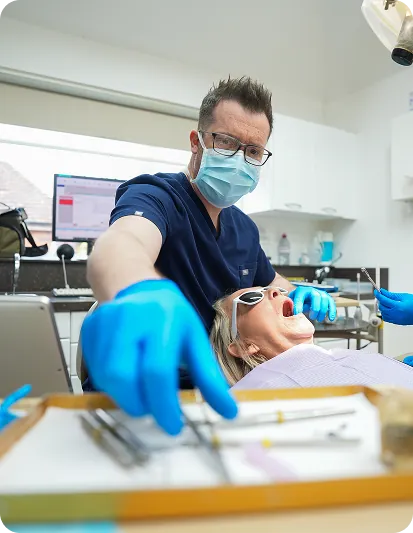
Implant surgery is usually performed with local anaesthetic; sedation options are discussed if appropriate but are not guaranteed.
Healing and bone integration are monitored; timelines vary and temporary restorations may be used while the site matures.
The final bridge or removable overdenture is fitted when clinically ready and a maintenance schedule for professional reviews and home care is agreed.
Suitability varies between patients and requires an individual clinical assessment. Full-arch implant treatment may be considered when many teeth in an arch are missing, remaining teeth have a poor prognosis, or a conventional denture causes difficulty, but it is not appropriate in every case.
Remaining teeth should be assessed carefully and those that can be maintained and restored are not removed simply to enable implants. Your medical history, current medicines, smoking, bone quantity and quality, oral hygiene ability and expectations all influence the plan, and we will explain alternatives such as restoring suitable teeth, using a conventional denture or choosing an implant-retained removable option if these are more appropriate.
Additional services that support full-arch treatment include:
Professional hygiene care to manage gum health before and after implants, including tailored cleaning routines and reviews; long-term care may include professional hygiene care.
Restorative dentistry for crowns and bridges where remaining teeth can be preserved and improved.
Tooth extraction and socket management when needed for overall treatment planning.
Bone grafting and soft tissue management when clinically required and discussed as options.
Routine reviews to monitor implants, gums and the prosthetic components over time.
Advice and practical training for cleaning around fixed or removable implant restorations at home.
If you are travelling from Becket Keys Church of England School, Start Smiling Dental Practice is based in Ingatestone and is reachable by car, train or bus. Our reception team can answer practical questions about scheduling appointments to suit your travel needs and help you prepare for your first visit.
To discuss a consultation about full arch dental implants for someone near Becket Keys Church of England School, call Start Smiling Dental Practice on 01277 353456 to talk through the assessment process and likely fees. Because full-arch plans vary by clinical need, the current fee guide is a useful starting point before a personalised estimate is prepared. Our address is Start Smiling Dental Practice, 5 Market Place, Ingatestone, Essex, CM4 0BY.