Replace One Missing Tooth
01
An implant-supported crown may replace one missing tooth where suitable, following clinical assessment and careful planning.
If you are looking for dental implants near Queen’s Hospital, Start Smiling Dental Practice in Ingatestone can help you understand whether implants may suit your needs. Dental implants are artificial tooth-root replacements placed in the jaw to support a crown, bridge or denture and are considered after careful assessment.
Start Smiling Dental Practice is based in Ingatestone and welcomes patients from Queen’s Hospital and the surrounding Romford area. We provide private dental practice care for implants within a calm, modern setting and will explain the clinical assessment, options and likely next steps when you visit.

Implants can be used in a number of restorative ways to address missing teeth and improve function in suitable patients.
An implant-supported crown may replace one missing tooth where suitable, following clinical assessment and careful planning.
Two or more implants can support a bridge to restore a run of missing teeth and improve biting function for some patients.
Implants can help retain and stabilise removable dentures, improving comfort and chewing confidence for patients who struggle with traditional dentures.
Implants may restore the ability to bite and chew more comfortably compared with some removable options in suitable cases.
Replacing missing teeth with appropriate restorations can contribute to facial support when bone and soft tissues are adequate.
An implant crown can be an alternative to a bridge that would require reshaping adjacent healthy teeth in some situations.
Implants provide fixed or removable restoration options that can be integrated with your ongoing dental care and maintenance.
Start Smiling Dental Practice is based in Ingatestone and welcomes patients from Queen’s Hospital.
Your care is provided by our dental team who will discuss options and answer questions throughout treatment.
We listen to your goals and explain options in plain language so you can make an informed decision.
We use current records and imaging where clinically appropriate to assist restorative planning.
We outline the likely stages of treatment, investigations and follow-up so there are no surprises.
Professional reviews and home-care advice are arranged to protect implant health over time.
Each plan is tailored to your oral health, medical history and treatment goals after assessment.
A clinician reviews your medical history, gums, remaining teeth and treatment goals to consider suitability for implants.
X-rays and digital scans may be taken where clinically appropriate to plan implant position and any restorative work.
Active gum disease, failing teeth or other issues will be managed before implant placement when required, and some patients may need bone grafting to create a stable foundation.
The implant post is placed in the jaw, commonly under local anaesthetic; the team will explain what to expect before and after the procedure.
Time is allowed for the implant to integrate with bone and for soft tissues to recover; follow-up reviews monitor progress and healing varies between patients.
A crown, bridge or denture is fitted once planning and healing are complete; regular maintenance and reviews are arranged to protect implant health.
Deciding whether dental implants are suitable requires a personalised clinical assessment. Your clinician will consider oral and gum health, the quality and quantity of jawbone, the condition of remaining teeth, your bite, medical history, medications and smoking status.
Implant placement is a surgical procedure and, while many implants integrate successfully, failures and complications can occur. We will discuss likely benefits, potential risks, alternative treatments such as bridges or dentures, and the investigations needed so you can give informed consent.
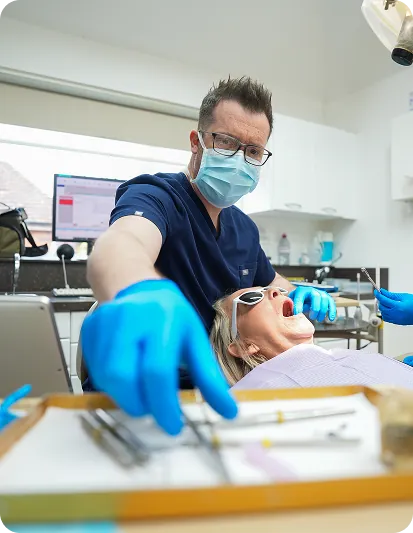
We provide a range of care to assess and support implant treatment before and after placement.
Oral health checks to assess gums and remaining teeth before implant treatment.
Hygiene appointments to reduce inflammation and support healing, and to help maintain implants long term via good hygiene care.
Digital records and radiographs when clinically appropriate to guide accurate planning for dental implant treatment.

Restorative dentistry to prepare neighbouring teeth or fit final crowns, bridges or dentures, including coordination for crowns and bridgework where needed with crowns and bridges.
Post-operative reviews following implant placement to monitor integration and healing.
Long-term maintenance plans to protect implant health and restorations.
Start Smiling Dental Practice is based in Ingatestone and welcomes patients from Queen’s Hospital. We will explain the appointment process, what records may be needed and how follow-up care is arranged.
If you would like to discuss dental implants near Queen’s Hospital, phone Start Smiling Dental Practice on 01277 353456 to arrange an initial consultation at our Ingatestone practice.
During the consultation we will assess your suitability, explain any required investigations and outline possible options so you can make an informed decision.